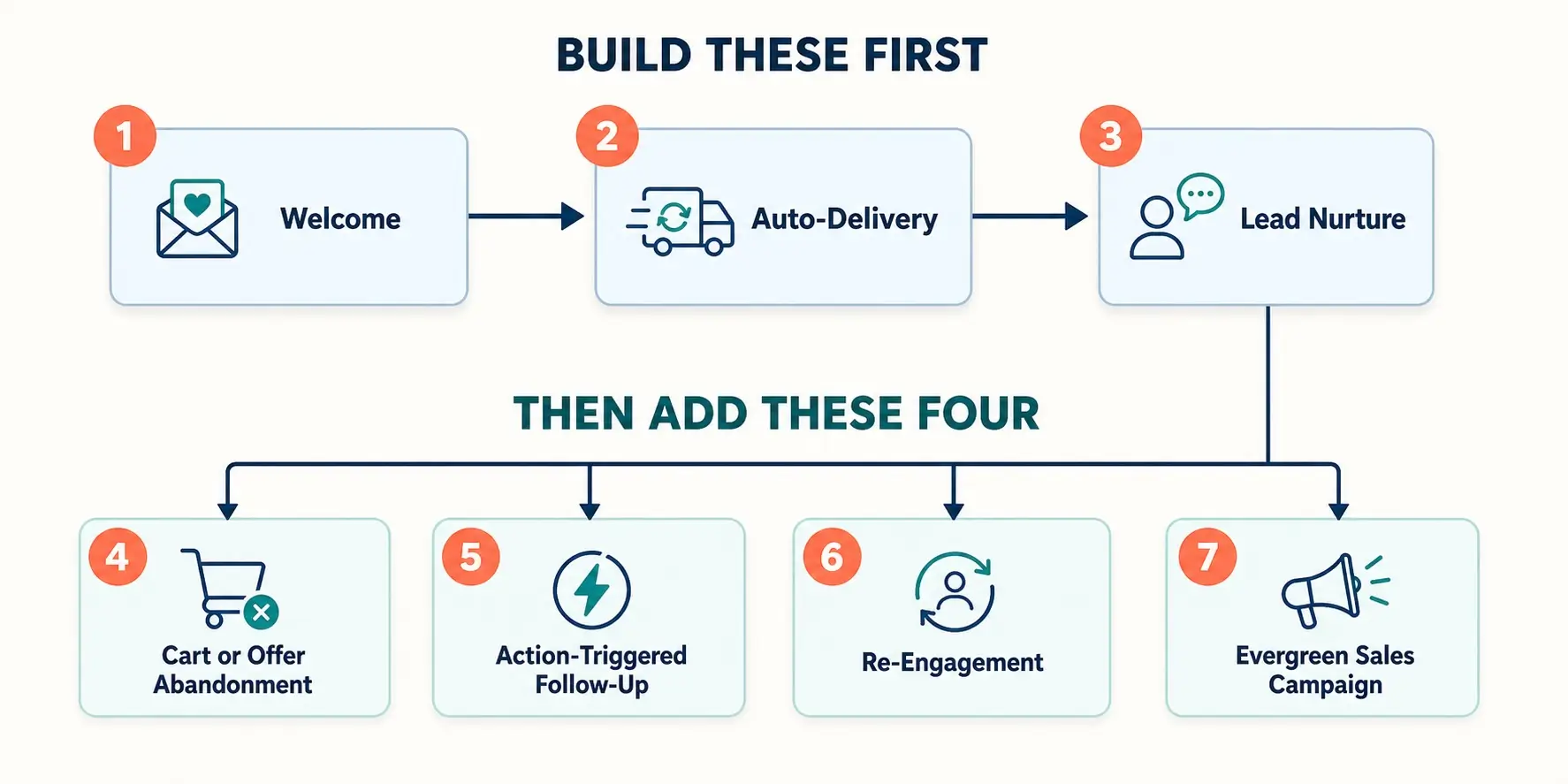
If you've got a welcome email going out and a monthly newsletter, it's tempting to call your marketing "automated." Most business owners we work with start there, and most of them are leaving revenue on the table without realizing it. A real automation setup does the selling, the following up, and the re-engaging while you're doing literally anything else, and it only takes seven campaigns to cover the whole customer journey.
A welcome sequence of 3 to 5 emails sets the tone for the entire subscriber relationship, and it's the single highest-leverage campaign to build first if you're starting from zero.
Abandoned cart, welcome, and browse abandonment emails together account for 87% of all automated order revenue, according to Omnisend's 2026 benchmark data, which makes cart abandonment one of the highest-return campaigns on this list.
Re-engagement campaigns targeting subscribers who've gone 90+ days without opening an email can win back a portion of that list before you'd otherwise remove them.
Why These 7 (Not 27)
You could build twenty different automated campaigns for your business and burn out trying to maintain all of them. We've found seven that cover the full life of a customer relationship, from the moment someone opts in to the moment they're ready to buy again. Build these in Keap, or whatever CRM you're on, and you've got a system running in the background instead of a to-do list that never ends.
The order matters here too. Some of these campaigns need to exist before others make sense, and I'll flag that as we go.
The 7 Campaigns
1. The Welcome Campaign
This is the first automated message a new subscriber, lead, or customer gets, and it sets the tone for everything after it. A good welcome campaign does three things: it confirms they're in the right place, it tells them what to expect (how often you'll email, what kind of content), and it asks for one small action, like replying to a question or checking out your most popular resource. If you haven't built yours yet, 5 Steps to Craft the Perfect Welcome Email walks through each email in the sequence.
Skip this step and you're asking a cold subscriber to trust an offer before you've earned it.
2. The Auto-Delivery Sequence
If someone takes an action, like registering for a webinar, downloading a guide, or booking a call, they need the details immediately, not whenever you get around to it. Auto-delivery is the simplest campaign on this list to build and the easiest to overlook. A prospect who signs up for a webinar and doesn't get the dial-in link within a minute or two starts to wonder if the whole thing is legitimate.
3. Lead Nurture
Lead nurture is the education layer. It's a series of emails that walks a prospect through what you do, why it works, and what results other clients have gotten, spread out over days or weeks instead of dumped on them all at once. This is where most of the actual persuading happens, well before anyone sees a sales pitch. We go deeper on building this sequence in The Power of Email Nurture Campaigns for Lasting Relationships.
Nurture emails generate 4 to 10 times the response rate of a standalone email blast, and nurtured leads go on to make purchases 47% larger than leads who never got a nurture sequence, according to Salesgenie's research on lead nurturing performance. A nurture sequence of 5 to 7 emails, spaced two to three days apart, gives a prospect enough time to absorb one idea before the next one lands.
4. Cart or Offer Abandonment
Someone added a product to their cart or started filling out a form and left. This campaign brings them back with a short sequence: a simple reminder first, then a message with social proof or an answer to a likely objection, then a final nudge with urgency if that fits your offer. Three emails, sent over 24 to 72 hours, will do more work than one generic "did you forget something" email ever will, and it's one of the campaigns responsible for that 87% figure above.
5. Action-Triggered Follow-Up
This campaign fires based on specific behavior, not a fixed schedule. Someone watches a demo video to the end, or clicks a pricing link, or views a case study twice. That's a signal, and it deserves a response that's more specific than your general nurture sequence. If a lead watches your demo all the way through, the next email shouldn't be a generic newsletter, it should reference the demo directly and offer the next step.
6. Re-Engagement
Every list has subscribers who've gone quiet. A re-engagement campaign targets anyone who hasn't opened an email in 60 to 90 days with something different, a direct question, a strong offer, or an honest "we'll stop emailing you if you don't want this anymore." This does two things: it wins back some of those subscribers, and it tells you who to remove from your list so your sender reputation stays healthy. Boost Your Email Open Rates: 5 Tips for Success covers what to check if your whole list's engagement is sliding, not just the inactive segment.
This campaign only works once you already have the other pieces in place, since it depends on knowing what "normal" engagement looks like for your list.
7. The Evergreen Sales Campaign
Your evergreen sales campaign is the one you can run repeatedly without rebuilding it every time. Build it once around a specific offer, tie it to a recurring trigger like a seasonal promotion, a milestone, or a limited-time bonus, and reuse it. This is the payoff campaign. Everything above it exists to warm people up so this one converts.
What to Build First
If you're starting from nothing, build in this order: welcome campaign, auto-delivery, lead nurture, then the other four. The first three get people into your world and keep them there. The last four are about catching specific moments, and they work better once you've got real subscriber behavior to learn from.
Most of our clients get all seven running within 60 to 90 days when we build them into Keap together. You don't need all of them live on day one. You need the first one live this week.
Frequently Asked Questions
What order should I build these marketing automation campaigns in? Start with the welcome campaign, then auto-delivery, then lead nurture. Those three cover how new leads and subscribers experience your business in the first few days, and they need to be solid before the behavior-based campaigns (abandonment, action-triggered, re-engagement) have anything useful to react to.
How many emails should a welcome campaign have? Three to five emails over the first one to two weeks works for most small businesses. The first email should confirm the opt-in and set expectations, and each one after that should build toward your first real offer or ask.
What's the difference between lead nurture and a sales campaign? Lead nurture educates, and it's not trying to close anything yet. A sales campaign asks for the purchase directly, usually with a specific offer, deadline, or bonus attached. Nurture builds trust first. Sales campaigns spend that trust.
How long should a cart abandonment sequence be? Three emails sent over 24 to 72 hours covers most cases: a plain reminder within a few hours, a follow-up with social proof or an objection-handler the next day, and a final nudge with urgency on day three.
Do I need all 7 campaigns before automation is worth it? No. Even one or two of these, built well, will save you hours a week and catch sales you're currently losing to silence. The welcome campaign and auto-delivery sequence alone are worth building first since they touch every new lead or customer.
Can these campaigns be built in any CRM, or do I need Keap specifically? The strategy works in any CRM with automation and tagging capability. We build these in Keap because it handles the tagging, triggers, and campaign logic in one place, which matters once you've got all seven running and need them to talk to each other.
If your business is running on a handful of manual emails right now, you don't need to build all seven of these at once, and you shouldn't try. Pick the one that's missing and causing you the most pain, whether that's leads going cold with no nurture or carts getting abandoned with no follow-up, and start there. The rest can come one campaign at a time.
0 Comments